Frontier Crime and Memory
The Northfield Raid of 1876: Reading the Record Behind the Legend
Eight riders, one bank, a short and confused fight on Division Street. A guide to what the 1895 book, the state encyclopedia and the town’s own history center actually agree on, and where they quietly don’t.
The Northfield raid is one of those events everybody half-remembers. A famous gang rides into a small town, expects an easy bank, and gets shot to pieces by farm-town shopkeepers. Parts of that are true. Parts of it were polished into legend within a generation. This guide takes the three most accessible sources, an 1895 book, the Minnesota Historical Society’s encyclopedia entry and the town’s own history center, and sets out what they agree on, what they don’t, and what nobody can know.
At a glance
- When: the afternoon of Thursday, September 7, 1876 (sources differ on the hour; see below).
- Where: Division Street and the First National Bank, Northfield, Minnesota, a college and mill town on the Cannon River.
- Outcome: no money taken from the vault; two raiders and two townsmen killed during the raid, and a two-week manhunt that ended near Madelia on September 21.[1, 2]
- Best free sources: J. L. Huntington, Robber and Hero (1895), at the Library of Congress, and MNopedia’s “Northfield Bank Raid.”[1, 2]
The town and the bank
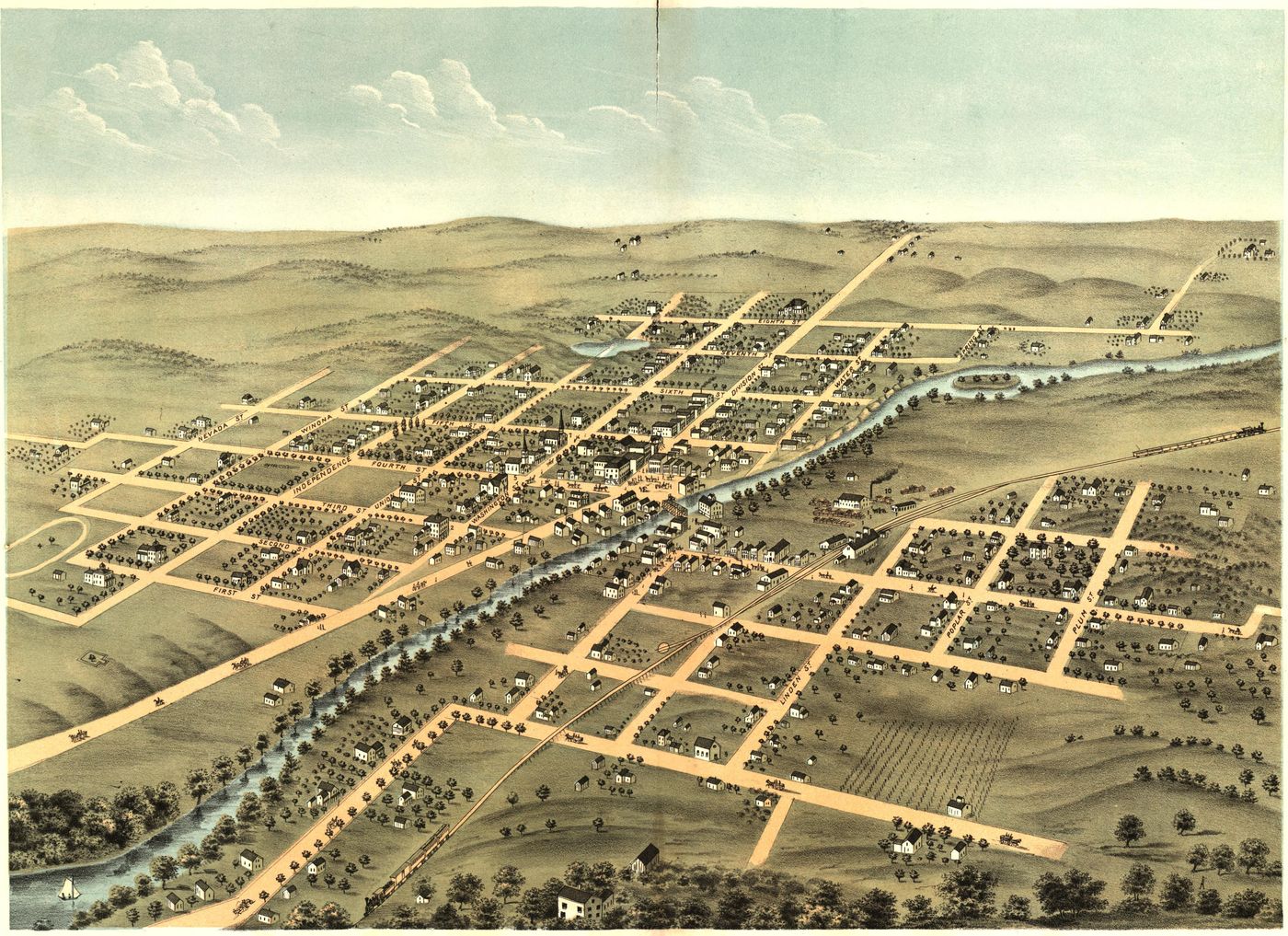
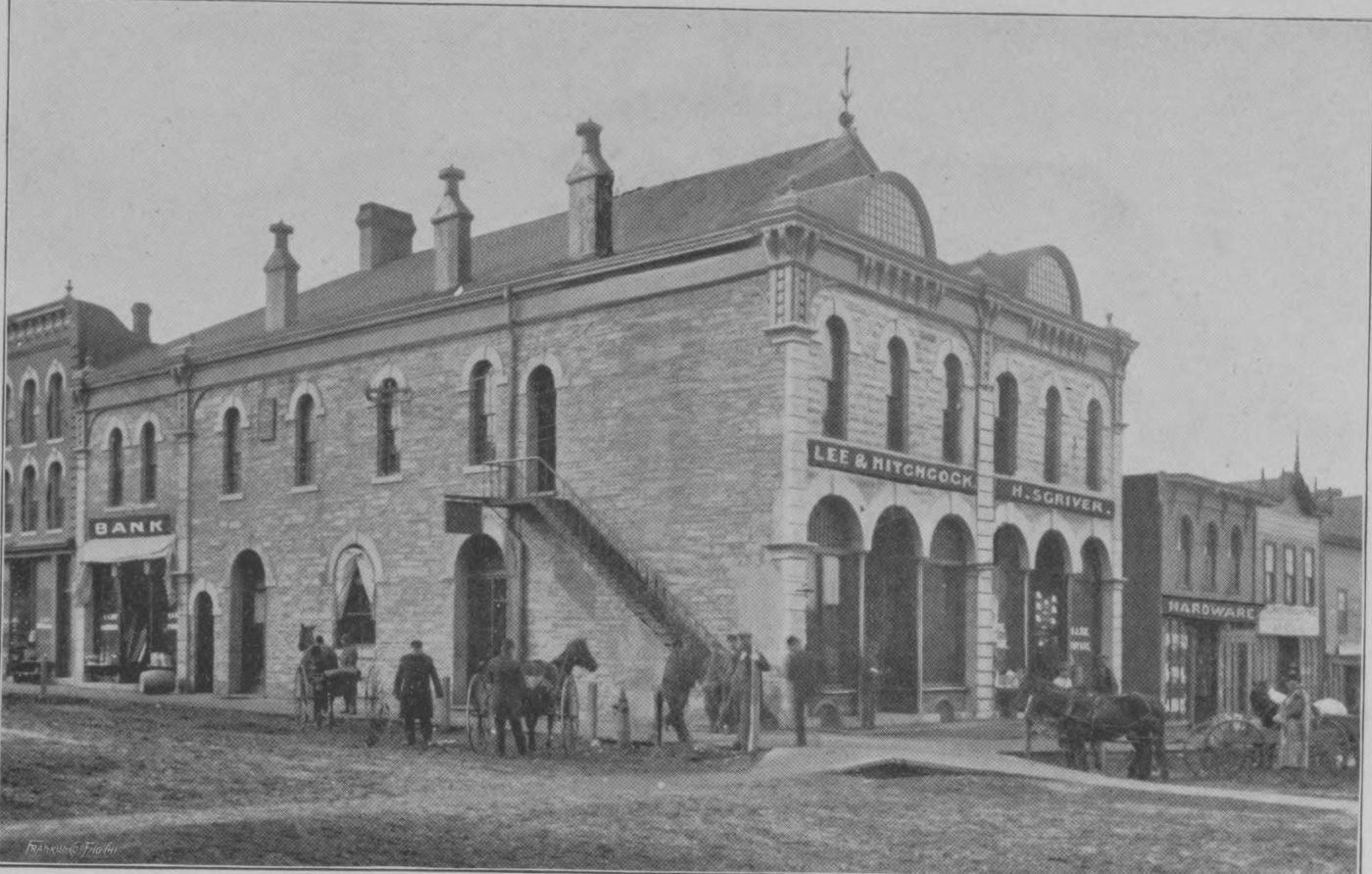
Northfield in 1876 was a Rice County town on the Cannon River, with mills and a college. A bird’s-eye lithograph published in 1869 shows the town seven years before the raid.[3] The First National Bank stood on Division Street, a main street that Huntington’s book illustrates with a printed plate of the bank building as it looked in 1876.[2]
Why did the gang choose Northfield? Later writers offered motives, but there is no contemporary statement from the raiders that fixes one. The common explanation, that they expected an easy target in a quiet town, is a reconstruction. What the documents can show is the day itself: eight riders reached town and the town resisted.[1, 2]
The afternoon, in outline
All three sources agree on the date, the place and the basic shape: eight men took part, three entered the bank and the rest stayed outside to keep the street.[1, 2, 4] They do not agree on the hour. MNopedia and the Northfield History Center put the start at around two o’clock in the afternoon, while Huntington quotes a bankers’ circular of 1877 as saying the eight “rode into town about noon.”[1, 2, 4] A careful writer therefore says “that afternoon” and leaves the clock out. It is a small detail, and a good example of why a single account should never be used as an authority on its own.
Inside the bank
Three bank employees were in the building. The acting cashier was Joseph Lee Heywood, who is described in Huntington as the bank’s bookkeeper. Huntington also states that at the time of his death Heywood “was the City Treasurer and also the Treasurer of Carleton College.”[2] The raiders demanded that he open the vault. Heywood did not, and he was shot and killed inside the bank.[1, 2]
Whether the vault was actually locked, set on a time lock or only made to appear locked is a point on which later accounts differ. What is not in dispute is the result: the vault stayed closed to the raiders and they left with little or nothing from the cash drawer.[1, 2, 4]
Teller Alonzo Bunker ran for the back. Huntington reports that he was shot through the right shoulder, “near the joint, barely missing the sub-clavian artery,” and that he “ran on across a vacant lot and around to a surgeon’s office in the next block.” Both secondary pages agree that he was shot in the shoulder and escaped.[1, 2, 4]
The Library of Congress holds a carte-de-visite portrait of Heywood. On the back it carries the bank’s own stamp, dated September 28, 1876, three weeks after the raid. It shows how quickly his image was being put to public use.[5]
Division Street
Outside, the raiders had spread along the street. The fight began when a townsman, the hardware merchant J. S. Allen, was told to get back inside and instead shouted a warning, according to Huntington and the History Center.[2, 4] What followed was not an organized posse. It was shopkeepers, clerks and a medical student, shooting from doorways and windows.
The medical student was Henry Wheeler. Huntington says that he turned into the Dampier Hotel, “close at hand,” and found “an old army carbine, for which, with the help of Mr. Dampier the clerk, three cartridges were discovered,” and that he was “at a second-story chamber window, with his gun loaded, in time for the beginning of the fight.”[2] MNopedia, by contrast, describes a third-floor window.[1] Both can’t be literally right, and the 1895 account is the one that quotes the witness closely. A merchant named Anselm Manning also fired from the street.[1, 2]
The outcome of the street fight is consistent across sources. Two raiders, Clell Miller and the man usually named Bill Chadwell, were killed in the street. Nicolaus Gustafson, a Swedish immigrant (the name is also spelled Gustavson), was shot and died several days later.[1, 2, 4] Later retellings stretch the incident into a long Western shootout. The contemporary descriptions are of a short and chaotic exchange in a narrow street, followed by a flight to the horses.[2]
Where the sources disagree
Almost every popular telling of Northfield includes at least one claim that the evidence cannot support. These are the main points of genuine disagreement.
- The hour. Around two o’clock (MNopedia, History Center) versus “about noon” (the bankers’ circular, as quoted by Huntington).[1, 2, 4]
- The window. Second-story in Huntington; third-floor in MNopedia.[1, 2]
- Who the three inside were. Identifications of the raiders by name do not all agree. This guide does not offer a roster because the record does not fix one.[1, 2]
- Who shot Heywood. Survivors and later writers named different men. The 1876 inquest is reported to have found an unknown shooter, and we will not pick a name the record does not fix.
- The raider called Bill Chadwell. Some accounts give his name as William Stiles. Newspapers of the time used Chadwell.[1, 4]
- Who killed which raider. Popular histories credit particular townsmen with particular shots. Those credits are made after the fact, so treat them as claims.
The hunt and the end of the gang
Two of the men split off during the flight and escaped. Later writers and newspapers identified them as Jesse and Frank James, and they were never tried for the Northfield raid. The Younger brothers, when taken, would not name their companions.[1, 2]
For roughly two weeks, posses searched the woods and prairie of southern Minnesota for the remaining four, Cole, Jim and Bob Younger and Charlie Pitts. Huntington records that on Thursday, September 21, news arrived that the four had been located near Madelia.[2] Pitts was killed in the final fight. The three Youngers were taken alive, wounded, and brought into town. They pleaded guilty and were sentenced to life in the Minnesota State Prison at Stillwater.[1, 2]
The prison years were not long for everyone. Huntington reports that Bob Younger died there on September 16, 1889. Standard biographical summaries put the parole of Cole and Jim in 1901, Jim’s death the next year and Cole’s in 1916. (Sources give different days for the parole in July 1901, which is why we give only the year.) Jesse James never went to Stillwater. He was shot in St. Joseph, Missouri, by Robert Ford on April 3, 1882, as is well documented outside the three sources used here.
Memoir, legend and the paper trail
Cole Younger spent his later years telling his own story, and in 1903 published a memoir.[6] A memoir is a participant’s later account. It tells you what he wanted remembered, which may or may not match what happened. Huntington’s book appeared in 1895, nearly two decades after the raid, and gives Heywood and the townsmen the leading roles.[2] The two do not tell the same story, and neither does the printed legend that sold the James brothers in songs and cheap prints. The raid broke the James-Younger gang; the legend grew in the opposite direction.
The lesson for anyone reading about Northfield is simple. Prefer sources written near the event, check their claims against each other, and mark every statement whose only support is a later book. That is slower than repeating the legend, but the legend is the part of this story that has been repeated enough.
How to research it yourself
- Read Huntington. The Library of Congress and Project Gutenberg both host the 1895 text. It is the best single source for the detail of the day, and it names its own authorities.[2]
- Cross-check with MNopedia and the History Center. Note every point on which the three differ and keep a list. The disagreements are the interesting part.[1, 4]
- Look for 1876 newspapers. The Minnesota Digital Newspaper Hub holds Minnesota papers from the period. Search September 1876 for “Northfield.”[7] Local papers from the time will often differ from the books written afterward.
- Treat memoirs as memoirs. Cole Younger’s 1903 book is a legitimate source about what he said, not a neutral record of what occurred.[6]
If you visit Northfield
Northfield celebrates the raid and its aftermath, and the Northfield History Center is the place to start for the town’s own account.[4] Opening hours and exhibits change, so check the center’s site before you go. If you want to follow the story on foot, take the 1869 map and the plate from Huntington’s book with you and compare them with what stands there now.[2, 3]
Watch the companion episode
Forgotten Frontier Outfitters is preparing a video on this subject. It is not public yet, so we are not linking one. In the meantime, the Forgotten Frontier Outfitters channel has our other history and folklore episodes.
A note on this page: because the raid killed people, we do not attach shirts, products or store promotions to this guide.
Further reading
- J. L. Huntington, Robber and Hero (1895), free at the Library of Congress and Project Gutenberg: a detailed account published in 1895 that quotes the bankers’ circular of 1877.
- Cole Younger, The Story of Cole Younger, by Himself (1903): a raider’s memoir, to be read as memoir.
Sources
Numbered in order of first citation. Links open the original or the library record.
- Minnesota Historical Society, MNopedia, “Northfield Bank Raid.” mnhs.org/mnopedia.
- J. L. Huntington, Robber and Hero: The Story of the Raid on the First National Bank of Northfield, Minnesota, by the James-Younger Band of Robbers in 1876 (1895). Library of Congress, loc.gov/item/14017034; also Project Gutenberg #44415, gutenberg.org/ebooks/44415.
- Ruger & Stoner, “Bird’s eye view of Northfield, Rice County, Minnesota 1869.” Library of Congress, loc.gov/item/73693459.
- Northfield Historical Society / Northfield History Center, “1876 Bank Raid.” northfieldhistory.org/1876-bank-raid.
- Carte-de-visite portrait of Joseph Lee Heywood, bearing the bank’s stamp dated September 28, 1876. Library of Congress, loc.gov/item/2004679863.
- Cole Younger, The Story of Cole Younger, by Himself (1903). A memoir, written decades after the raid; use as one participant’s later account.
- Minnesota Historical Society, Minnesota Digital Newspaper Hub: newspapers.mnhs.org. Search September 1876 issues for “Northfield.”