Strange Skies
Washington, D.C., July 1952: Radar, Pilots and the Weather Explanation
Two Saturday nights, radar screens at the nation’s capital and an Air Force press conference. A reader’s guide to what the newspapers, the transcript and the scientists’ later analysis actually say.
In July 1952, two Saturday nights of unidentified radar returns over the capital of the United States produced front-page headlines, a rare Pentagon press conference and an official explanation. People still argue about whether that explanation fit. The useful way to join the argument is to read what each side actually put on paper: the Washington newspapers, the stenographic transcript of the July 29 briefing, and the scientific study that looked at the case seventeen years later. This guide goes through them in order, and says plainly where the record stops.
At a glance
- When: the nights of July 19–20 and July 26–27, 1952 (both Saturdays).
- Where: the skies over Washington, D.C., seen on radar at Washington National Airport, Andrews Air Force Base and Bolling Air Force Base, and reported visually by pilots and ground crews.[1]
- The official answer: weather (a temperature inversion bending radar beams) for the radar targets, and meteors and stars for the lights.[1, 2]
- Best free primary sources: the Evening Star in Chronicling America, the July 29, 1952 press-conference transcript, and Chapter 5 of the Condon report’s Section III.[1, 2, 3]
The first Saturday: July 19–20
The Condon report’s radar chapter, written by Gordon D. Thayer, gives the bare frame: radar sightings in the Washington area between 11:40 p.m. local time on July 19 and 5:40 a.m. on July 20, with the weather “mostly clear, a few scattered clouds,” visibility ten to fifteen miles, light winds, and temperatures from 76 to 87 degrees Fahrenheit.[1] The Evening Star reported the story on July 22 under the headline “Objects in D.C. Sky,” describing seven unidentified objects picked up on radar over Washington and and referring to an interrogation of a pilot, Capt. Pierman, and others.[3]
The more detailed narrative commonly told comes from later collected accounts, including Ruppelt’s 1956 book and the secondary histories built on it: a controller at Washington National Airport named Edward Nugent noticed seven targets south-southwest of the city; his supervisor, Harry Barnes, had the equipment checked; the targets were then said to have moved toward restricted airspace near the White House and the Capitol; and interceptors from Delaware arrived in the early morning, after which the targets reportedly faded and later returned.[4] Treat those names, times and intercept details as later reports. We have not seen a July 1952 primary document that confirms each of them, and the people involved were describing events afterward.
The Condon report prints a few statements by ground personnel at Andrews Air Force Base from that night. The tower operator there wrote that an airman had reported an “orange ball of fire, trailing a tail” that “took off at an unbelievable speed,” and the operator himself recorded watching a star and falling stars from the tower roof, adding that he and another man “believed we saw it move too. Such is the power of suggestion.”[1] Those are two accounts from the same tower on the same night, and they point in different directions. That is the case in miniature.
The second Saturday: July 26–27
The Condon analysis treats both weekends together. It says unidentified radar targets began appearing at 8:30 p.m. on July 25 and at 8:50 p.m. on July 26, and that on the 26th the targets “continued until after midnight.”[1] Later narratives add details of a second night: a National Airlines crew reporting lights, interceptors being vectored toward the blips, a Blue Book spokesman present at the airport radar center, and a request to photograph the radar scopes that was refused.[4] As with the first night, those come from later accounts. What the primary record supports is simpler: two nights, radar targets reported at multiple sites, and visual reports that did not line up neatly with them.
That last point is important. The Condon report says that in most instances visual observers, “especially in scrambled aircraft, were unable to see targets indicated on ground radar,” and that radar tracks from Washington National, Andrews and Bolling “are generally not correlated with each other, with airborne radar/visual observations, or with ground visual reports, except in a very general way.”[1] The legend says radar and eyewitnesses saw the same thing at the same time. The report’s authors say that, in the files they examined, such agreement was not generally established.
The July 29 press conference
On Tuesday, July 29, Major General John A. Samford, the Air Force’s Director of Intelligence, took questions from reporters at the Pentagon. The Army Signal Corps filmed part of his statement, and the film is in the National Archives.[5] The typed transcript also survives and has been digitized.[2] The Evening Star reported on the radar story again that day.[6]
The transcript records Captain James, an Air Force officer, answering questions on the radar. Asked whether the disappearance and reappearance of the blips could be explained by the movement of a cloud bank that reflected a ground target, he said: “Well, actually, it’s not a cloud bank. It’s a temperature inversion of the atmosphere. You see, if warm air comes in over a cool area, you have a temperature inversion and the atmosphere can be perfectly clear, and still the rays will be bent.”[2]
It is worth reading the next lines of the transcript carefully, because they are more hedged than the summary that circulated afterward. Asked whether that would account for the images disappearing and reappearing on the screens, he said: “I’m not positive about that. There’s a possibility.” Asked whether there had been a temperature inversion in the area the previous Saturday night, he said: “There was.” Asked about the Saturday night before that, he said: “I’m not sure about the one preceding, but there was last Saturday night.” Asked about the night before the press conference, he said: “I don’t know.” And asked whether any two radar sets in the area had gotten a fix on the same object, he answered: “The information we have isn’t good enough to determine that.”[2]
Put together, the transcript shows an Air Force officer offering an inversion as the likely mechanism, confirming one for the second Saturday, declining to say whether one existed on the first, and admitting that the data did not settle whether two radars had tracked the same target. That is a narrower statement than the headline version, “the Air Force says it was weather.”
The weather explanation, stated fairly
Normally air cools with height. On some summer nights a layer of warmer air sits above cooler air near the ground, a temperature inversion. Radar beams can then bend, strike the ground or a ship or a building, and return to the scope as a target that appears to be in the sky. The Condon report accepts this as the likely explanation of the radar returns and gives its reasons.
First, the upper-air soundings. The report examines radio refractivity profiles from Silver Hill, Maryland, for July 19, 25 and 26. The July 19 profile at 10 p.m. shows a surface inversion of 1.7 °C, though the report notes the resulting gradient was only about twice the standard value; the July 25 profile shows a strong elevated duct and a 4.6 °C inversion; and the July 26 profile shows a 1.2 °C surface inversion plus a smaller elevated inversion strong enough to produce anomalous-propagation effects on radar.[1] The author adds that Silver Hill sits 75 meters higher than the airport and that records from soundings launched at Washington National in earlier years show a stronger tendency toward anomalous propagation than the Silver Hill data do.[1]
Second, a contemporary radar study. The Condon chapter discusses a paper by Borden and Vickers, published in 1953, which reported that on the night of August 13–14, 1952 the authors observed radar tracks “very similar” to those of the July incidents. The targets moved with the winds aloft at about twice their speed, which suggested ground returns seen through patches of the inversion layer. The Condon author calls it “an excellent analysis of the probable radar situation during the July 1952, Washington sightings.”[1]
Third, the conclusion. The report states that the atmospheric conditions during those nights “were conducive to anomalous propagation of radar signals,” that the radar returns “were most likely the result of anomalous propagation,” and that the visual objects were “with one or two possible exceptions, identifiable as most probably meteors and scintillating stars.”[1]
What the radar men said, and what the scientists said later
The weather answer was not universally accepted by the people in the radar rooms. Ruppelt wrote in 1956 that the controllers disagreed with it, and later reports say a Navy radar specialist at the airport thought the inversion that night was too weak to explain returns that looked solid.[4] Those are secondhand views, put in print years afterward, and should be read that way.
The Air Force’s own files are partly online: the Project Blue Book archive includes a Washington, D.C. file dated August 1952. It is a later official record and not a case folder for the July nights, so read it as context.[7] Notice the careful wording the Condon chapter itself uses: “most likely,” “most probably,” and “with one or two possible exceptions.” It also says that in evaluating UFO phenomena “it is seldom possible to arrive at an incontrovertible conclusion.”[1] Even the skeptical document stops short of claiming certainty.
What is missing
The things most people would want are the things that do not appear to exist. No photograph of the radar scopes from either night has been located; the accounts say photographs were not made. There is no film of the lights and no known recording of the radio calls. The 1952 Blue Book file for Washington that survives is a later file rather than a July case folder. And the Condon report says that visual observers, especially in scrambled aircraft, were unable to see the targets shown on ground radar.[1] If the case is ever settled, it will be settled by documents, not by a photograph.
How to read the files yourself
- Start with the transcript. It is short, and the page with Captain James’s answers (page 10) is only a few lines. Read the hedges as well as the headline.[2]
- Read the Evening Star. Chronicling America holds the paper for July 1952. Search for July 22 (p. 15) and July 29 (p. 3) and compare the tone with the transcript.[3, 6]
- Read the Condon chapter. It is the best single document for the skeptical case, and it prints raw witness statements, including the one about the “power of suggestion.”[1]
- Treat Ruppelt as a witness. His book is vivid and influential, and it is a memoir.[4]
Where to see the places
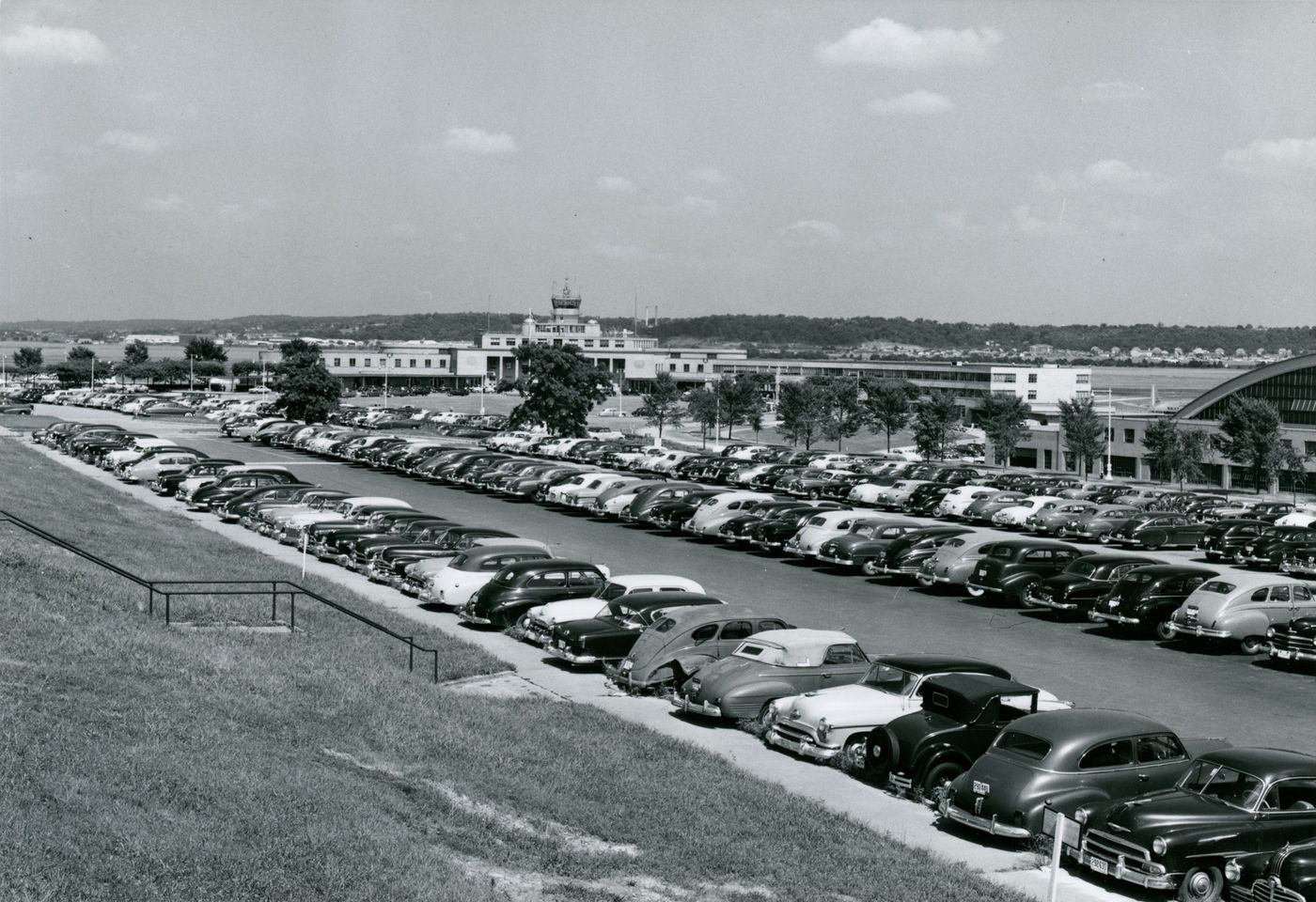
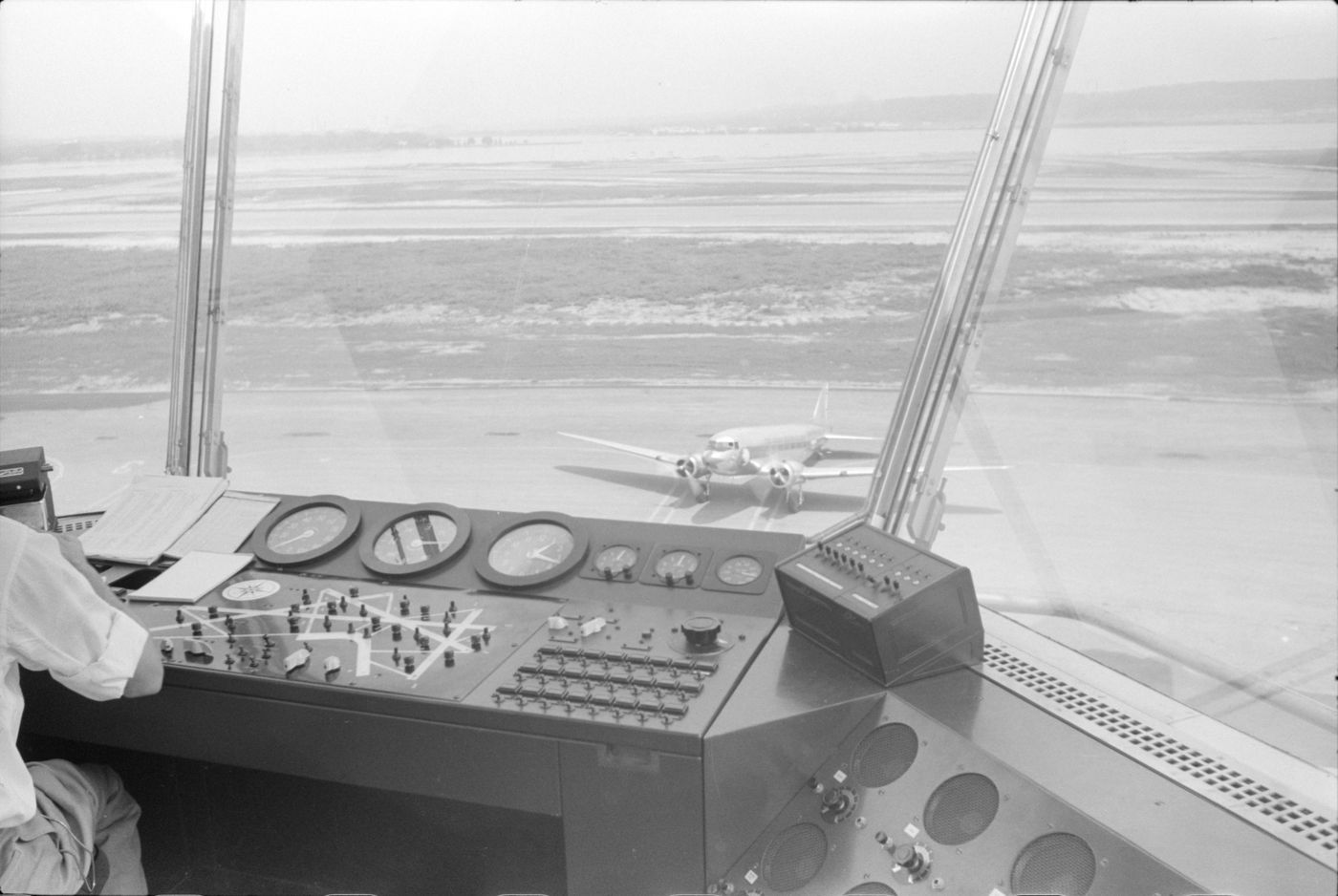
Washington National Airport, now named for Ronald Reagan, still serves the city. Its midcentury terminal is part of the story visually, and the National Archives holds a July 1952 photograph of the airport that month.[8] For the 1941 control-tower view and many other airport photographs, search the Library of Congress.[9] The National Archives also holds the Samford film, which can be watched online.[5]
Watch the companion episode
Forgotten Frontier Outfitters is preparing a video on this subject. It is not public yet, so we are not linking one. In the meantime, the Forgotten Frontier Outfitters channel has our other history and folklore episodes.
From our own shop: Forgotten Frontier Outfitters makes original frontier-and-folklore apparel and gifts. If you like this kind of story, see our strange and unusual designs. These are links to our own store, not third-party affiliate links; see the disclosure.
Further reading
- Edward J. Ruppelt, The Report on Unidentified Flying Objects (1956): the Blue Book chief’s own account of the summer of 1952.
- Edward U. Condon, ed., Scientific Study of Unidentified Flying Objects (1969), free online at ncas.org: the University of Colorado study, including the radar chapter cited above.
Sources
Numbered in order of first citation. Links open the original or the library record.
- Gordon D. Thayer, “Optical and Radar Analyses of Field Cases,” in Edward U. Condon, ed., Scientific Study of Unidentified Flying Objects (1969), Section III, Chapter 5; entry “Washington, D.C., 19–20 and 26–27 July 1952.” Online text: ncas.org/condon/text/s3chap05.htm.
- Transcript of the press conference held by Maj. Gen. John A. Samford, USAF Director of Intelligence, July 29, 1952 (page 10 for Capt. James’s answers). Digitized U.S. government record on Wikimedia Commons: “General Samford Press Conference, July 29, 1952”.
- Evening Star (Washington, D.C.), July 22, 1952, p. 15, “Objects in D.C. Sky.” Library of Congress, Chronicling America: loc.gov, July 22, p. 15.
- Edward J. Ruppelt, The Report on Unidentified Flying Objects (Doubleday, 1956). A memoir by the Air Force’s Blue Book head in 1952; cited here for what he wrote, as one participant’s later account.
- “Maj. Gen. John A. Samford’s Statement on Flying Saucers,” U.S. Army Signal Corps film, July 1952, National Archives (NAID 25738; 111-LC-30875). catalog.archives.gov/id/25738.
- Evening Star, July 29, 1952, p. 3, “Unidentified Objects Seen Again on Radar Screen at Airport.” Library of Congress: loc.gov, July 29, p. 3.
- Project Blue Book file, Washington, D.C., August 1952, U.S. Air Force record, Internet Archive: archive.org/details/1952-08-8756987-WASHINGTON-D-C. A later official record; it is not a case file of the July weekends.
- C. H. Ritter, photograph of Washington National Airport, July 1952, Bureau of Public Roads; National Archives, NAID 234117769, catalog.archives.gov/id/234117769.
- Jack Delano, “View from inside the control tower at the municipal airport, in Washington, D.C.,” July 1941, Library of Congress, loc.gov/pictures/item/2017749893.